


 Danish Wadhwa
 Dr. Varun Bajaj, MD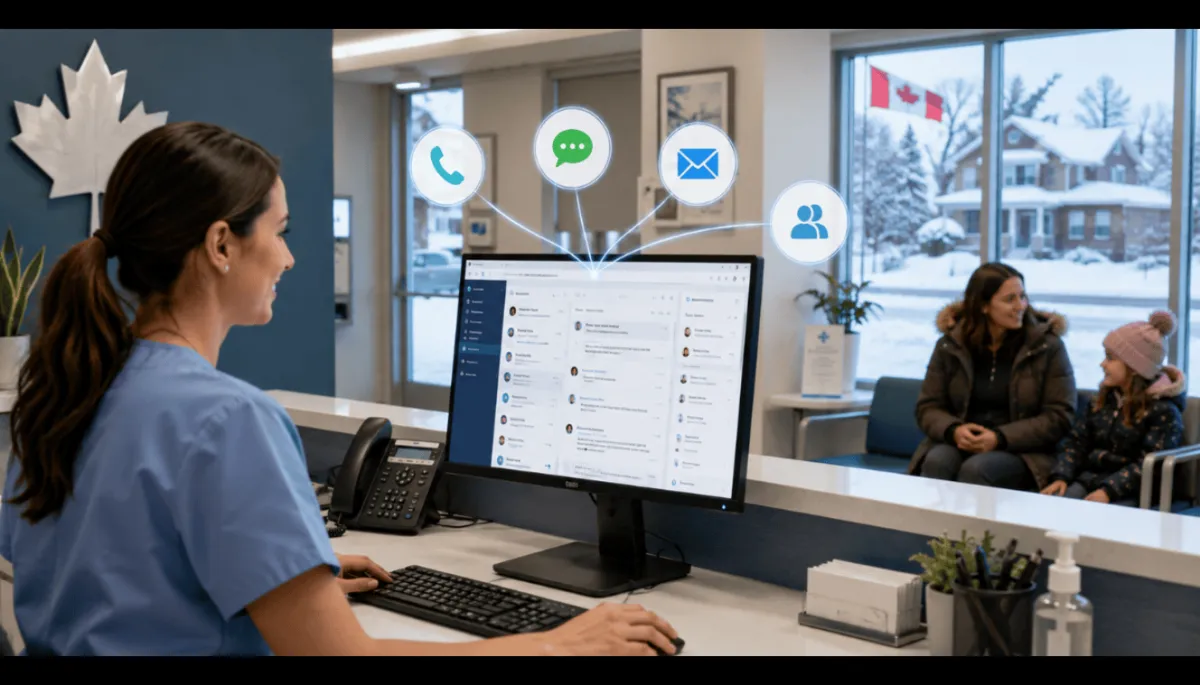
Picture a typical Monday morning at a Canadian clinic. The phone is ringing. A patient message from the website chat is waiting for a reply. Three text messages came in over the weekend. Someone left a Facebook message asking about appointment availability. And your front desk team, the same two people who check patients in, manage the schedule, and handle billing, is supposed to be on top of all of it simultaneously.
This is not a staffing problem. It is a systems problem. And it is one that a unified inbox solves directly.
What is a unified inbox in a medical setting?
A unified inbox is a single platform that consolidates all patient communication channels, phone, SMS, email, website chat, and social messages, into one shared dashboard that your entire team can access and manage from one place.
Instead of logging into five different apps to check messages across five different channels, your team sees every patient conversation in one feed. They can respond, assign, follow up, and resolve without switching between tools or missing messages buried in a platform nobody checked since Thursday. For small clinics managing communication manually, the unified inbox is one of the most immediate operational improvements available. For multi-speciality clinics with multiple providers, it becomes genuinely indispensable.
Why is communication crucial in healthcare?
Patient communication is not a back-office function. It is a clinical one. A patient who cannot reach your clinic to confirm an appointment does not confirm it; they miss it. A patient who sends a message about a medication question and receives no reply for three days loses trust in your practice. A new patient inquiry that sits unanswered for 48 hours books with a competitor instead.
The consequence of fragmented communication is not just operational friction. It directly affects patient outcomes, patient retention, and your clinic’s reputation. Studies consistently show that response time is one of the top factors patients consider when evaluating their experience with a healthcare provider, ahead of wait times and ahead of cost.
For clinics still managing communication through separate channels with no unified system, the cost is paid in missed appointments, lost patients, and staff teams that are perpetually overwhelmed by the volume of messages they are trying to track manually. Poor communication before appointments is also one of the leading causes of missed visits.
What are the benefits of a unified inbox for clinical communication?
Dramatically faster patient response times. When a message arrives and your team can see it immediately, regardless of which channel it came through, response time drops from hours to minutes. For new patient inquiries especially, speed is the deciding factor.
No message goes unanswered. The most common failure in multi-channel communication is the missed message: the text that came in during a busy hour, the website chat that nobody checked, the email that arrived Friday afternoon. A unified inbox eliminates these gaps by surfacing every conversation in one visible queue that the whole team shares.
Better team coordination. In a clinic with two or three front desk staff members, it is easy for the same patient to receive two different replies from two different people, or no reply at all, because each person assumed the other was handling it. A unified inbox shows which messages have been responded to, which are in progress, and which are still waiting.
Reduced staff burnout with clinical software. Staff burnout in clinic settings is frequently driven not by patient volume but by administrative fragmentation, the mental load of managing multiple tools and constantly context-switching between platforms. A single inbox, one interface, one place to start and end the day, has a measurable impact on how your team experiences their work.
A complete patient communication history. When every interaction with a patient across every channel is recorded in one thread, your team has full context before they respond. No more asking a patient to repeat information they already shared, and no more conflicting messages because different staff members had different pieces of the conversation.
How does a unified inbox improve clinic workflow efficiency?
The efficiency gains from a centralised inbox extend beyond the communication layer itself. When messages are consolidated, your team spends less time on tool-switching and more time on actual patient care. Triage becomes faster, and urgent messages can be flagged and escalated in seconds. Routine queries can be templated and replied to in one click.
For clinics that have paired a unified inbox with a booking calendar, the workflow becomes even more seamless. A patient messages asking for an appointment, the team replies with a booking link directly in the same conversation thread, and the appointment is confirmed without anyone making a phone call or switching between platforms. This kind of integrated workflow is what separates high-performing clinics from those constantly playing catch-up.
Is centralised communication only useful for large clinics?
The assumption that unified inbox tools are only for large hospital systems or multi-location groups is wrong. Small clinics, often operating with one or two front desk staff members and a high daily call volume, benefit most from centralised patient communication.
When a single staff member is managing phone, email, text, and chat simultaneously with no unified system, the failure rate is not a reflection of that person’s capability. It is a reflection of an impossible workload. Centralised communication makes that workload manageable. For small clinics exploring automation options, a unified inbox is typically the first and most impactful tool to implement because it immediately addresses the most visible daily pain point without requiring major process changes.
How does a unified inbox work for multi-speciality clinics?
For clinics with multiple providers, departments, or specialities, the unified inbox provides an additional layer of value: routing. Messages can be directed to the right provider or team automatically, reducing the back-and-forth that happens when a message comes in and nobody is sure who should handle it.
A physiotherapy inquiry goes to the physio team. A Botox question goes to the aesthetics coordinator. A billing question goes to the admin team. All from one inbox, with full visibility across the organisation. This also feeds directly into better reporting dashboard metrics when all communication flows through one system, letting you measure response times, message volumes, and channel effectiveness in a way that is impossible when data is scattered across separate tools.
How does HiClinic’s unified inbox work?
HiClinic’s unified inbox consolidates all patient communication, texts, calls, website chat, and social messages, into a single shared dashboard built specifically for Canadian clinics. It connects directly with HiClinic’s full platform:
- Auto Missed Call Text-Back — every missed call triggers an immediate text, so the conversation continues in the unified inbox rather than ending at voicemail
- AI Receptionist — handles after-hours and overflow inquiries that feed directly into the inbox queue for your team to review
- Patient Recall — automated recall messages generate replies that land in the unified inbox, ready for your team to follow up
- Booking Calendar — booking links sent in conversations convert directly into confirmed appointments without any additional steps
The result is a communication system that captures every patient interaction, responds faster than a manual approach can, and gives your team a manageable, organised view of everything happening in the practice.
Key takeaways
- A unified inbox consolidates phone, SMS, email, chat, and social messages into one shared dashboard.
- Fragmented communication directly affects patient outcomes, retention, and reputation, not just operational efficiency.
- Faster response times, no missed messages, better team coordination, and reduced burnout are the core benefits.
- Small clinics with limited staff often benefit the most from centralising communication.
- Multi-speciality clinics gain automatic routing so the right team sees the right message.
If you are managing patient communication across multiple channels today and finding it difficult to keep up, this is the tool that fixes it. Book a free demo to see how the unified inbox works for your specific clinic type.